Who answers?
Provider, business owner, technical owner, refresh schedule, and escalation path.
Flagship product · data knowledge
Know every connection, field, calculation, owner, and change.
SyncDesk is a structured knowledge workspace for data connections. It documents where data comes from, where it goes, who owns it, what it contains, how business logic is calculated, what changed, and which OpsDesk issue is linked.
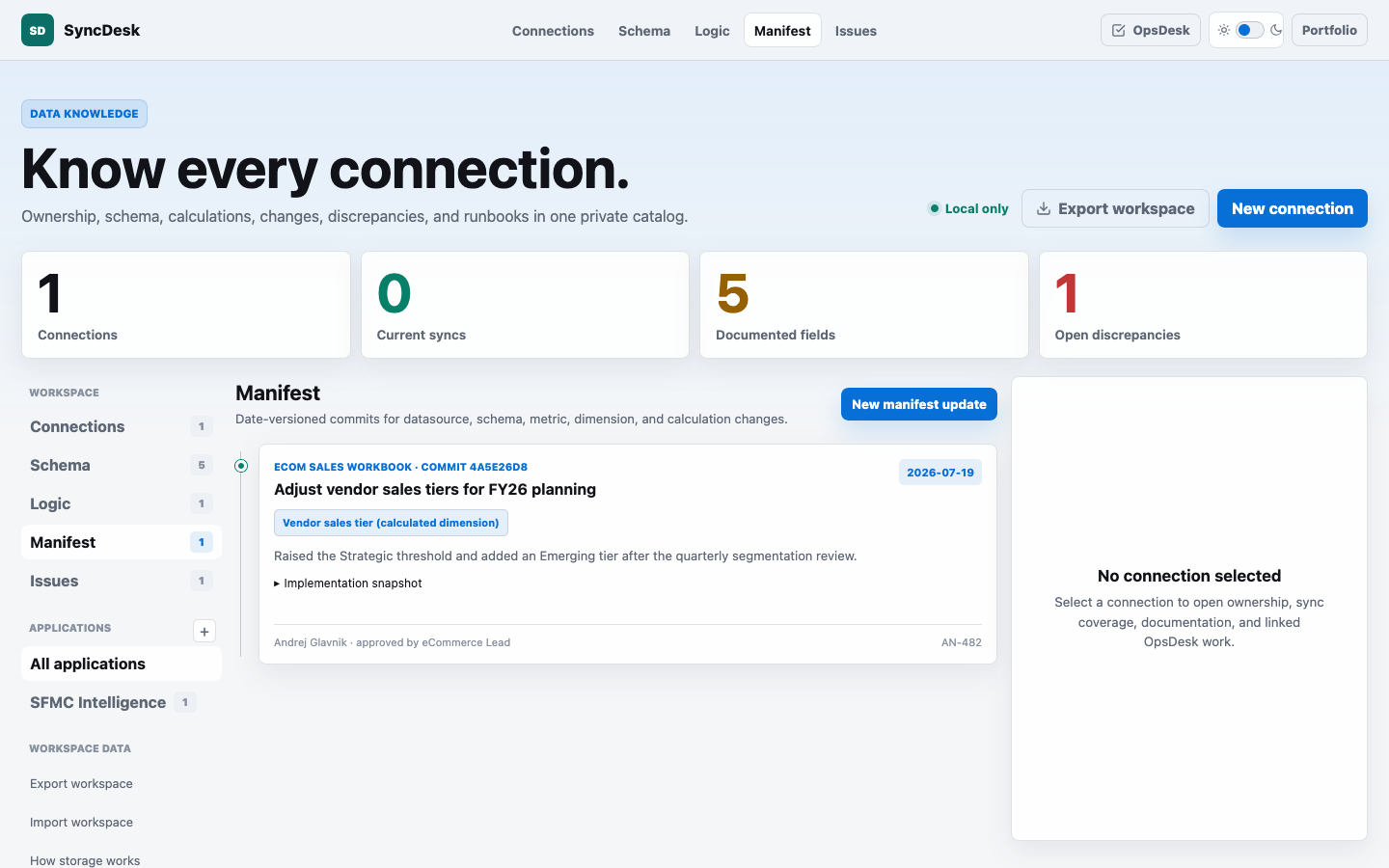 Connection context and change history live together, locally.
01 · Challenge
A number in a dashboard may begin in an Excel column, move through an API, become a calculated field, and change after a business decision. Without durable context, the next discrepancy becomes archaeology.
The goal was not another wiki page. It was a working catalog where connections, schema, logic, history, and operational issues remain linked.
Provider, business owner, technical owner, refresh schedule, and escalation path.
Fields, data types, metric logic, source mappings, and known limitations.
Date-based manifest updates linked directly to affected metrics and connections.
02 · Knowledge model
SyncDesk organizes knowledge around five connected objects. Each can stand alone, but the value comes from their links.
eCommerce, CRM, media, support, or finance.
Source, destination, owner, provider, coverage.
Columns, dimensions, metrics, types, samples.
Formula, dependencies, output, caveats.
What changed, why, who approved, what is affected.
03 · Manifest
Versions use dates instead of abstract v1.1 labels. Every manifest update can tag the exact connection, metric, dimension, or calculated field affected by the change.
Updated the normalization rule after the business introduced a new distributor hierarchy.
CASE
WHEN vendor_tier = 'Strategic' THEN parent_vendor
WHEN vendor_name IS NULL THEN 'Unknown'
ELSE vendor_name
ENDecom.xlsx → vendor_name
SFMC Intelligence → Vendor Group
Marketing Command Center → Sales by vendor
Owner: Analytics Operations
Approved by: eCommerce lead
Effective from: 2026-07-19History reads naturally and remains aligned to release, incident, or decision timing.
Opening a metric shows its definition, setup, dependencies, and every manifest entry that tagged it.
Knowledge explains the system; OpsDesk owns the operational investigation and follow-up.
04 · Result
SyncDesk gives analysts and project teams a practical place to capture source details, owners, refresh windows, schema, calculated logic, discrepancies, runbooks, and dated changes. The shared JSON workspace keeps SyncDesk and OpsDesk compatible.
Knowledge is organized around how people investigate data, not around one long documentation page.
Definitions and dates are no longer separated from the decisions that changed them.
OpsDesk and SyncDesk data travel together in the same JSON backup and can be restored later.
Excel, CSV, and Markdown reports communicate the catalog while JSON remains the complete restore format.